
The standard early-stage prospecting stack is three subscriptions doing three jobs: Crunchbase tells you who raised money, Apollo tells you who works there, and Hunter tells you whether the email is real. Each is good at its job. Together they cost more than most founders realise and still leave the hardest part (connecting the three) as manual work.
This breaks down what each tool does, what the combination costs, how far you can get free, and when the DIY route stops making sense.
What the three tools actually do
Crunchbase: the funding layer
Crunchbase answers "which companies just raised money." It's the category default for funding intelligence, with strong coverage of announced rounds, investors, and amounts.
What it doesn't do: give you a person to contact. You learn that a company raised a Series A, and then you start a completely separate search for a human being and an email address.
Apollo: the contact layer
Apollo answers "who works there and what's their email." A very large contact database with search, filtering, and built-in sequencing.
What it doesn't do well: guarantee the email is current. Coverage is broad but re-verification is inconsistent, and untouched Apollo exports are a well-known source of high bounce rates. Treat its addresses as candidates.
Hunter: the verification layer
Hunter answers "is this address actually deliverable." Its domain search reveals a company's address pattern and its verifier is usefully conservative. It returns "risky" instead of guessing.
What it doesn't do: find companies. It's a lookup and verification layer, not a database you browse.
What all three cost together
Published list pricing on annual billing, September 2026:
| Tool | Plan | Monthly | Annual |
|---|---|---|---|
| Crunchbase | Pro | $49 | $588 |
| Apollo | Professional | $79/user | $948 |
| Hunter | Growth | $104 | $1,248 |
| Combined | $232 | $2,784 |
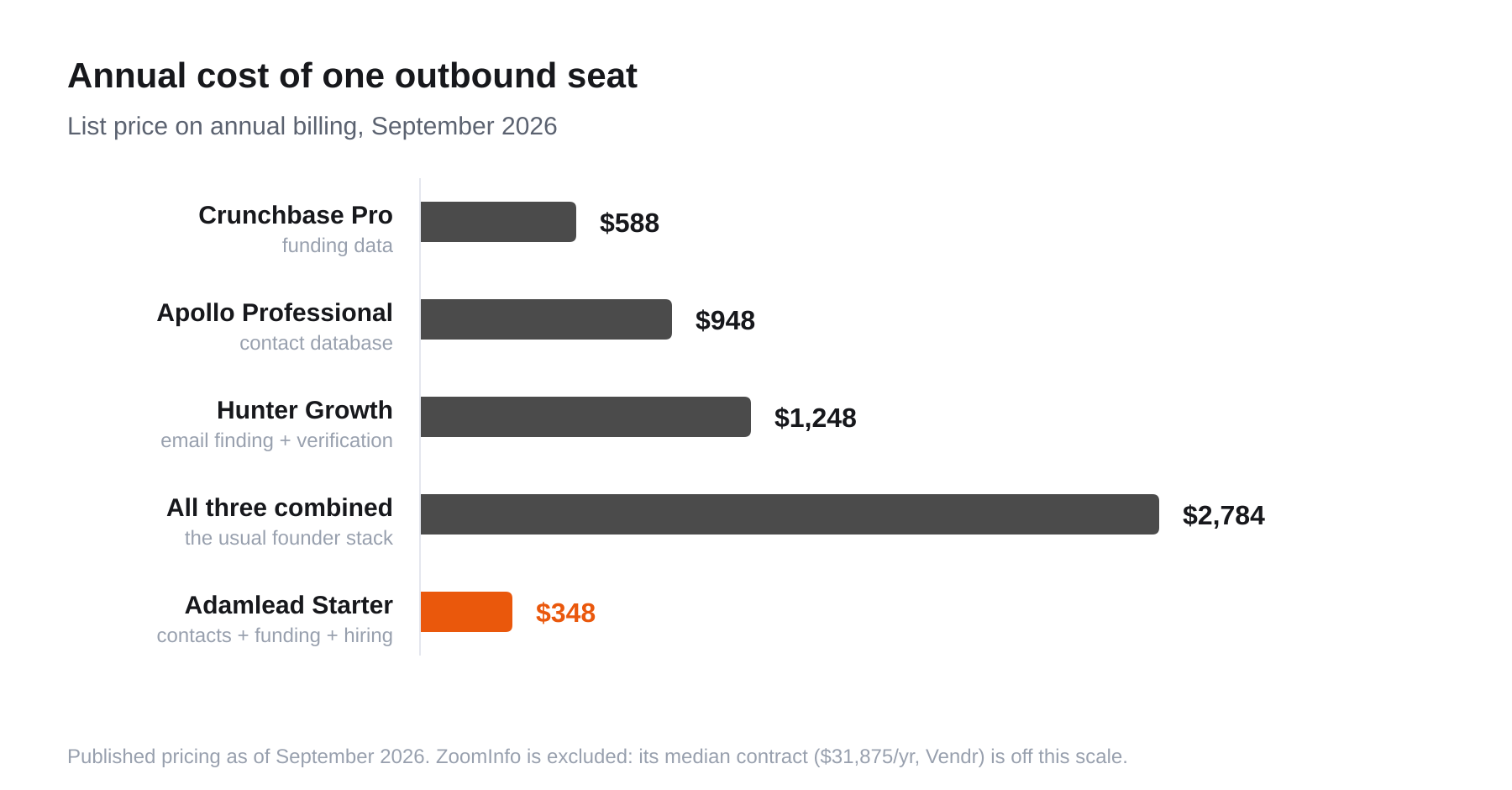
The usual founder stack against a single narrower tool. ZoomInfo is left off the chart because its median contract ($31,875/year according to Vendr marketplace data) is off this scale entirely.
That's $2,784 a year for one seat, before anyone sends an email, and before the sending tool, the CRM, or the calendar tool that follow.
How far the free tiers get you
Pretty far, if your volume is low and your time is cheap:
- Crunchbase free: basic company profiles and limited search. Enough to check a specific company; not enough to build a list of everyone who raised this month.
- Hunter free: 25 searches and 50 verifications per month. The most useful free tier of the three. Enough to confirm address patterns at ~25 companies monthly.
- Apollo free: limited credits, full search. Enough to identify people; export limits bite quickly.
- Public funding news: TechCrunch, Axios Pro Rata, and the funding announcements companies publish themselves are free, and they're the same primary source the paid databases index.
- Company careers pages: free, and a better hiring signal than most paid "intent" products, because a published job opening is a stated intention rather than an inferred one.
The manual free workflow
If you want to run this at zero cost:
- Scan funding news weekly and note companies matching your ICP.
- Open each company's site; find the team page and the careers page.
- Use Hunter's free searches to confirm the address pattern.
- Infer the founder's address from the pattern.
- Verify it with one of your 50 free monthly verifications.
- Log everything in a spreadsheet so you don't redo it next month.
This works. It costs about 15–20 minutes per company, which at 40 companies a month is roughly two full working days.
Which of the three do you actually need?
Before replacing anything, work out what you're really short of. Most teams need fewer than three:
- You only need the funding trigger. You already know who to contact at target companies, you just need to know when something changed. Crunchbase alone, or free funding news, covers it.
- You only need contacts. Your target list is fixed and timing doesn't matter much, like an established-market ICP instead of a fast-moving one. Apollo alone covers it.
- You only need verification. You're sourcing contacts elsewhere (manual research, inbound, events) and just need to not bounce. Hunter, or a cheaper dedicated verifier, covers it.
- You need the join. You need to know who raised, who to talk to there, and whether the address works, all connected. This is where you end up buying all three, and where the manual stitching cost lives.
Only case 4 justifies three subscriptions, and case 4 is also the one where three subscriptions solve it least well, because the connecting work stays manual regardless of how much you spend.
The costs that don't appear on the pricing page
Sticker price understates all three:
- Credit systems. Apollo meters export credits and mobile credits separately. Heavy outbound routinely exceeds the included allowance, and overage is billed on top.
- Per-seat multiplication. Apollo prices per user. A three-person team on Professional is $2,844/year for that line alone, not $948.
- Annual lock-in. The advertised prices above are annual-billing rates. Month-to-month costs a lot more. Crunchbase Pro doubles from $49 to $99, and Hunter's Starter goes from $34 to $49.
- Re-revealing the same contact. Worth checking explicitly in any tool you evaluate: does looking up a contact you already paid for cost a second credit next quarter?
- The spreadsheet. The real line item. Two working days a month of founder time doing manual joins is the largest cost in the stack and the only one nobody invoices you for.
Where the DIY route breaks down
Stitching the free tiers together is viable until one of these becomes true:
- Volume. Past about 25 companies a month, Hunter's free verification cap is the binding constraint.
- Freshness. Funding news scanned weekly means you're 3–10 days behind, and the whole advantage of a funding trigger is arriving early.
- Decay. Contact data goes stale at about 2.1% per month. A spreadsheet built six months ago has already lost ~12% of its deliverability, silently.
- The join. This is the real cost. Nothing in the chain talks to anything else. "This company raised a round" → "here's the decision-maker" → "here's a verified email" is a manual connection you make by hand, for every prospect, every time.
- Your time. Two working days a month at any reasonable valuation of a founder's time exceeds the cost of every tool discussed here.
What the alternative looks like
The gap isn't any one of those three tools. Each does its job well. The gap is that nobody sells the join. A combined, verified database means the company, the person, and the confidence-scored email are already connected when you open the record.
That's specifically what Adamlead does, for one narrow slice: startups that just raised funding.
- Every company on file has a known funding date: the same trigger you'd use Crunchbase for.
- Decision-makers are ranked by seniority: the job Apollo does.
- Every email carries a status and a 0–100 confidence score: the job Hunter does.
- Open roles come from the company's own careers page, not an inferred intent model.
Pricing is $29/month for 2,000 contact reveals or $59 for 5,000, roughly an eighth of the $2,784 combined stack. Every account starts with a 7-day free trial with 25 reveals, no card required.
Browse recently funded startups to see the actual data before creating anything, compare more sales intelligence tools, or see pricing.
All pricing verified against published vendor pricing pages, September 2026. ZoomInfo figure from Vendr marketplace data. Decay rate from HubSpot database decay research.