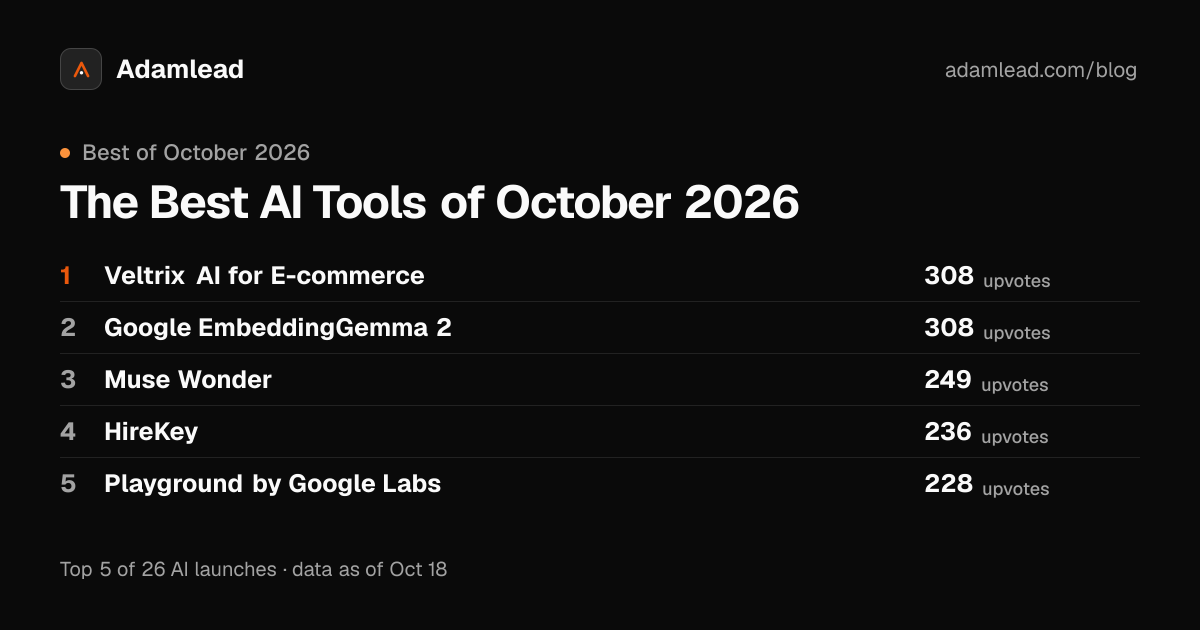
Every morning Junior pulls in the previous day's Product Hunt launches and sorts them by category.
In the first 18 days of October, 26 of them were filed under AI.
That sounds low, until you notice most "AI" products now file themselves under productivity, developer tools or marketing. What's left in the AI category is interesting for a different reason. It's where the big labs launch their models, and where small teams launch tools that do one specific job really well.
Here are the ten with the most upvotes, what each one actually does, and who it's for.
1. Veltrix AI for E-commerce
308 upvotes, #2 on October 2 · veltrixai.ai
Veltrix looks at your sales, costs, customers and marketing, and tells you where the money is.
What to promote. Where to cut spending. What's holding the business back. You connect your tools or upload files, and you start with a Business Health Check that flags improvements you might have missed.
Who it's for: e-commerce owners who have the data but not the time (or the analyst) to read it.
I like that the #1 AI tool of the month so far isn't a model. It's a tool for one kind of business, solving one kind of problem.
2. Google EmbeddingGemma 2
308 upvotes, #1 on October 12
An open embedding model from Google DeepMind that maps text, code, images, video and audio into one shared space. So one query can search across all of them.
The interesting part is the size. At 740M parameters it runs on a phone: about 567MB of RAM for the full multimodal model, 191MB for text only. It's Apache 2.0 licensed, with weights on Hugging Face and Kaggle.
Who it's for: developers building search or recommendations who want it to run on-device, or just cheaply.
3. Muse Wonder
249 upvotes, #4 on October 13
Meta's new model series for personal and professional agents, in two sizes: Muse Wonder and Muse Wonder Full.
Two features stand out. Active Memory carries your context across conversations. Active Focus keeps working through blockers on harder goals. Meta also says it's stronger at law, finance, health and coding. It's live on the Meta Model API and in Muse Code.
Who it's for: teams building agents who want another frontier option.
4. HireKey
236 upvotes, #1 on October 11 · hirekey.io
A job-search co-pilot for people in tech.
It helps you judge whether a role actually fits, tailor your resume, explain your experience, track applications, and practise interviews out loud. The difference from a basic ATS tool, according to the launch, is 10 years of recruiting experience at Microsoft, Amazon and Stripe built into the advice.
Who it's for: tech job seekers who are tired of sending 200 applications into the void.
5. Playground by Google Labs
228 upvotes, #3 on October 9
Describe a game. Pick a genre. Google's AI builds a playable version in minutes.
Then you change the rules, characters, physics or visuals by chatting, and share it with friends or the community gallery. No code.
Who it's for: anyone who's ever had a game idea and no way to build it. Probably a lot of kids, too.
6. Microsoft-Decision-1
173 upvotes, #4 on October 10
A small model that does one thing: picks between fixed options.
You give it choices, and it returns a calibrated probability for each in a single pass, as structured output your software can act on. Think routing, classification, verification, and deciding what an agent should do next. Microsoft says it's about 35x faster than its big general model at median latency.
Who it's for: developers whose agents spend most of their time making small decisions with an expensive model.
7. Odyssey 3
159 upvotes, #5 on October 9 · odyssey.dev
A "world model": you prompt an environment, and it predicts in real time how that world changes as you or an agent act in it.
The launch says the Pro version posts the highest reported Physics-IQ Verified video-to-video score, 66.1. The same model has been adapted to control robot arms and humanoids, drive a car, and train agents.
Who it's for: robotics and simulation teams, and anyone training agents that need to act in a physical world.
8. Fish Audio Drama 3
123 upvotes, #7 on October 16
AI voice acting you can direct.
You control emotion, pacing, whispers, laughter and pauses in plain language, even inside a single sentence. It does multi-character scenes, audiobooks, game dialogue and narration across 83 languages, on web, mobile and API.
Who it's for: audiobook producers, game studios and video creators who need performances, not just a voice reading text.
9. Nimble
86 upvotes, #14 on October 14
Another decision model, launched four days after Microsoft's.
Nimble-v4 and Nimble-v4-max claim scores of +5.74 and +10.5 above their benchmark baseline on the Decision Index.
Who it's for: the same developers as Microsoft-Decision-1. Two decision models in one week is a signal, more on that below.
10. Basedash chat dashboard preview
81 upvotes, #18 on October 1
Ask for "a sales dashboard with pipeline, win rate and revenue by rep", and it builds the whole thing in the chat: KPIs, charts, tables, filters and tabs. You can change filters and switch tabs right there, then open it as a full dashboard when it looks right.
Who it's for: sales, support, product and finance teams who need a dashboard today, not after a ticket to the data team.
Three more worth a look
- Krea 3 (78 upvotes) edits images at native 2K in under 8 seconds, for $0.06 an image, with up to 6 reference images to keep products and characters consistent across a campaign.
- Nemotron 3.5 Super VL (78 upvotes) is NVIDIA's open multimodal model for specialised agents: 120B parameters with 12B active, handling text, images, documents and video.
- Clarity (77 upvotes) removes background noise and other people talking on a live call, so a voice agent only hears the caller.
What October is telling us
The big labs launch models. Small teams launch jobs.
Google, Meta, Microsoft and NVIDIA account for five of the top twelve, and every one of those is a model. The independent launches (Veltrix, HireKey, Basedash, Clarity) are tools for one person doing one task. If you're a small team, that's still the lane.
Small, specific models are having a moment.
An embedding model that fits on a phone. Two decision models in one week. A model that only cleans up audio. The pattern is clear: use a big model for the hard thinking, and a small one for everything you do a thousand times a day.
Open is the default for infrastructure.
EmbeddingGemma 2 and Nemotron both shipped open weights. When the building blocks are free, the value moves to whatever you build on top of them.
If you sell to these teams
A launch is when a small team is most open to conversations. They're watching their numbers, talking to users, and deciding what to buy next.
That's why I built Junior (not affiliated with Product Hunt). Every launch here comes with the makers behind it, so you know who to talk to.
The full list
This is the top ten of 26. The full ranked list of October's AI launches, with the makers behind each one, is here: The Best AI Tools of October 2026. It updates every morning until the month closes.
Which of these would you actually pay for?
Upvotes and ranks as of October 18, 2026. Product details come from each team's own launch description.